

When Your Family Doesn't Support Your Sobriety

One of the more difficult realities of recovery is realizing that the people you thought would support you the most, sometimes don’t.
When we imagine getting sober, we often picture our family cheering us on, encouraging us through the hard days, and celebrating our victories along the way.
We assume that once we decide to change our lives, the people closest to us will be the first to stand beside us. Unfortunately, that isn't always the case.
Many people begin their recovery journey with little to no support from their families. Some are met with skepticism and judgment. Others face criticism, resentment, or complete emotional distance.
While getting sober is difficult under any circumstances, trying to do it without the support of those you love can feel really shitty.
I come from what many people would consider a somewhat stable family. Neither of my parents smoked, drank, or used drugs. Looking from the outside in, most people would probably assume that having sober parents would have made my recovery journey easier. In some ways it should have.
However, addiction is often much more complicated than whether or not the people around you use substances themselves. My parents wanted me to stop drinking and using drugs. They desperately wanted me to get better. What they struggled to understand was what was really happening underneath my addiction.
They saw the substance abuse, the legal trouble, the rebellious behavior, and the chaos that seemed to follow me everywhere I went. What they didn't fully understand was the pain, shame, trauma, fear, and emotional struggles that were driving some of those behaviors.
Throughout the years, they tried many different approaches in an attempt to help me. They sent me to rehab. They turned me in to the police. They sent me to a behavioral modification boot camp in the Adirondack Mountains (ALE).
Their intentions were never malicious. Looking back, I can see that they were scared and desperately wanted their daughter back. They wanted someone, somewhere, to fix me.
The problem was that one major component was missing throughout much of that process: genuine support.
There was no shortage of consequences, treatment programs, or attempts to force change. What was lacking was understanding, compassion, involvement, and emotional support.
Many of the programs I attended encouraged family participation because recovery affects everyone involved. Yet any participation on my parents' end was often absent. The focus remained on getting me into another program rather than trying to understand why I kept returning to substances in the first place.
As the years passed and I continued to relapse, I watched hope slowly disappear from the people around me. Every promise I made and every attempt that ended in failure chipped away at the trust that remained. Eventually, my parents began to lose faith altogether. They started distancing themselves from me emotionally and physically.
There were long periods where I had little to no contact with my mother. My father eventually kicked me out of his house. I bounced from one place to another, staying with friends when I could, sleeping wherever I could find a place to stay, and spending periods of my life with no real stability at all.
It was an incredibly painful experience.
Not because I expected anyone to save me, but because deep down I wanted my family to believe in me. I wanted someone to see beyond the addiction and recognize that there was still a person underneath it all. I wanted someone to see the pain behind the behaviors rather than only the behaviors themselves. More than anything, I wanted support.
For a long time, I felt abandoned.
If you've ever experienced something similar, I want you to know that you are not alone. Family dynamics are complicated, and not every family has the tools necessary to support someone struggling with addiction.
Some families have been hurt so many times that they emotionally shut down. Some simply don't understand addiction. Others view substance use as a choice or a moral failing rather than a complex disease that often involves trauma, mental health struggles, and emotional pain.
Some believe that tough love is the only answer.
Then there are those who face an entirely different challenge — the families that struggle with addiction themselves.
For some people, getting sober means trying to recover in an environment where drinking and drug use are normalized. Maybe your parents drink heavily every day. Maybe your siblings use drugs. Maybe family gatherings revolve around alcohol. Maybe the people closest to you actively encourage the behaviors you're trying to leave behind.
In situations like these, recovery can feel almost impossible. Choosing sobriety may create tension within the family because your decision to change highlights unhealthy patterns that others are not ready to address.
Sometimes people will accuse you of thinking you're better than them. Sometimes they will pressure you to participate. Sometimes they will mock your recovery or minimize your accomplishments.
In these situations, it is important to remember that protecting your sobriety is not selfish. Creating boundaries with people you love does not mean you have stopped loving them. It simply just means you are prioritizing your well-being. You cannot heal in an environment that constantly pulls you backward.
Others face a different type challenge. Some people don't have family support because their loved ones have passed away. Losing a parent, sibling, spouse, or other close family member can leave a person feeling completely alone in the world.
Grief and addiction often become deeply intertwined, making recovery even more difficult. When you don't have family to lean on, it can feel as though there is nobody in your corner.
The good news is that family can take many different forms.
Recovery taught me that family isn't always defined by blood. Sometimes family is found in a recovery meeting. Sometimes it's a sponsor who answers the phone at two in the morning. Sometimes it's a mentor, a therapist, a church community, or a trusted friend who consistently shows up when you need them. Sometimes it's a group of strangers who understand your struggles because they've walked the same road themselves.
The support you need may not come from the people you expected it to come from, and that can be heartbreaking. It is okay to grieve that reality. It is okay to acknowledge the pain of wishing your family had shown up differently. But, it is also important not to allow that disappointment to become an excuse to give up on yourself.
If I had waited for everyone to understand me before I got sober, I would probably still be stuck exactly where I was. My recovery could not depend on whether to not other people believed in me.
At some point, I had to learn how to believe in myself.
That doesn't mean I did it alone. It means I found support elsewhere. I sought out people who understood addiction. I connected with others who had experienced similar struggles. I learned that building a support system is possible even when your biological family is unable or unwilling to provide one.
Today, my relationships with my family looks much different than they once did. Healing has occurred in many ways over the years.
Your sobriety is worth fighting for whether your family supports it or not. Your healing is worth pursuing whether anyone else believes in it or not. Your life has value regardless of who chooses to stand beside you.
Sometimes the people who should have been your greatest supporters won't show up the way you hoped they would. That hurts. It's painful, and it's something many people in recovery quietly carry with them. Don't let someone else's inability to support your recovery become the reason you stop fighting for yourself.
Keep going.
Find your people.
Build your support system.
Ask for help.
Stay connected.
Remember, that even if you have to take the first steps alone, you do not have to walk the entire journey by yourself.
Looking for Additional Support?
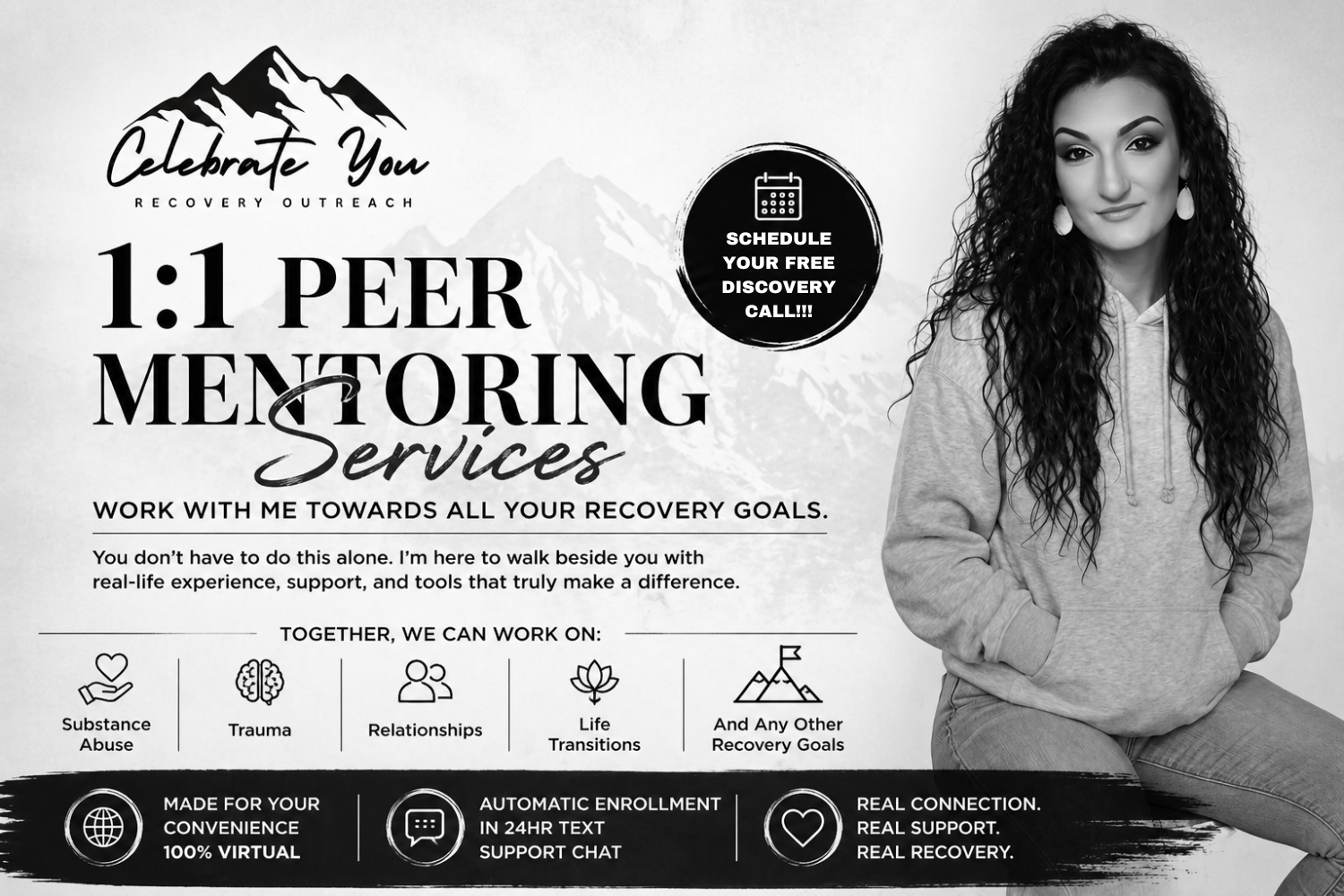
Recovery can feel overwhelming, especially when you're navigating it without the support system you wish you had. I offer one-on-one virtual peer mentoring services designed to meet you where you are.
As someone who has personally walked through addiction, homelessness, incarceration, grief, and long-term recovery, I understand that no two recovery journeys look the same.
Not sure if peer mentoring is right for you? That's okay. I invite you to visit our services page for a more in-depth look at what working together looks like, the support I provide, and how peer mentoring differs from traditional counseling or treatment services.
Still have questions? Let's connect. I offer a free discovery call where we can discuss your goals, answer any questions you may have, address concerns, and determine whether my mentoring services would be a good fit for your recovery journey.
Ready to take the next step? Sign up to schedule your free discovery call or learn more about my virtual peer mentoring services. I'd be honored to support you on your journey.
