How Trauma Changes Your Nervous System

There are still times in my life when I genuinely believe something might be wrong with me.
I couldn't understand why I always expected the worst to happen, why I found it so difficult to relax, or why my body seemed to react to situations before my mind had time to process what was even happening.
If someone I love didn’t answer the phone, my heart raced. If my children weren’t within sight, my mind immediately imagines every possible scenario that could go wrong. Even during moments that should have peace, I often find myself waiting for something bad to happen.
I blamed myself for these reactions. I thought I worried too much. I thought I was overly emotional or simply incapable of letting go of the past. It wasn't until I began learning about trauma, recovery, psychology, and the nervous system that everything started to make a little bit more sense.
I realized that my nervous system wasn't trying to sabotage my happiness—it was trying to protect me. The problem was that it had become so accustomed to danger that it no longer recognized when I was actually safe.
Trauma doesn’t end once the traumatic event is over. Trauma often stays with us long after the event itself has passed because it changes how our brains and bodies respond to the world around us.
Trauma is not simply the painful experience we went through, it is also the lasting impact that experience has on our nervous system.
Two people can live through similar events and have completely different responses because every nervous system is shaped by genetics, childhood experiences, previous trauma, support systems, and countless other factors.
Trauma isn't a competition, nor is it a measure of strength. It is simply the way our brains adapt when they believe survival is at stake.
Our nervous system has one primary responsibility — to keep us alive. Every second of every day, our brains are constantly asking “Am I safe?” When the answer is yes, our bodies function the way they were designed to. We are able to think clearly, connect with other people, sleep well, digest food properly, and experience joy.
However, the moment our brain perceives danger, our survival system takes over. This response is incredibly helpful during actual emergencies because it prepares us to protect ourselves.
The problem is that trauma can cause this alarm system to become overly sensitive, leaving it activated even when the danger has long since disappeared.
Many people are familiar with the phrase fight or flight, but researchers now recognize that there are actually four common trauma responses: fight, flight, freeze, and fawn.
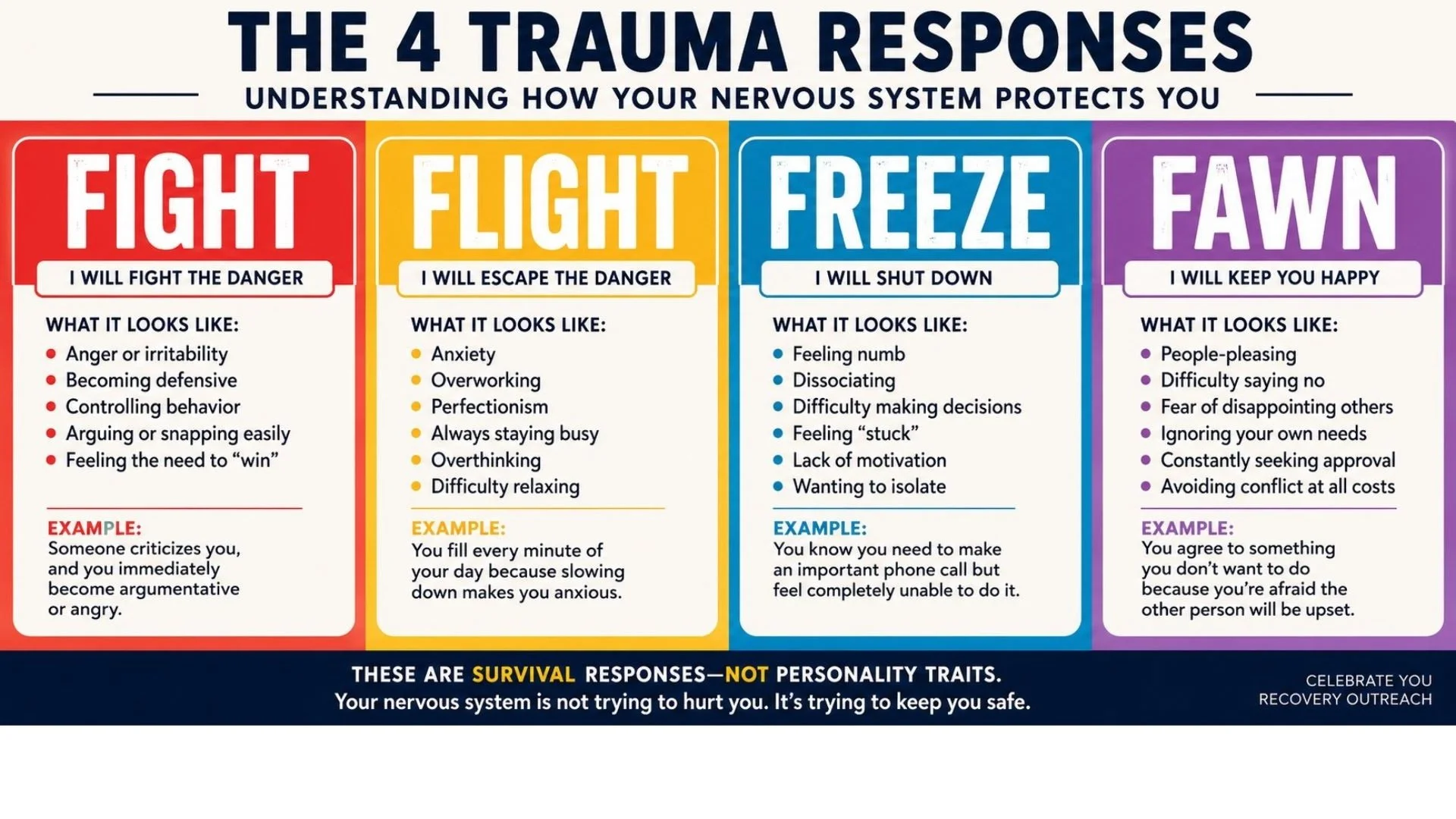
Some people become defensive, argumentative, or controlling because their nervous system believes fighting is the safest option. Others throw themselves into work, stay constantly busy, or become perfectionists because slowing down feels unsafe. Some individuals emotionally shut down or become numb, while others become chronic people-pleasers, believing that keeping everyone else happy will prevent conflict or abandonment.
These responses are not personality flaws. They are survival strategies that our nervous systems developed in an effort to protect us.
The difficult part is that survival mode often becomes so familiar that we stop recognizing we're living in it. We mistake constant anxiety for being responsible. We call hypervigilance intuition. We label emotional exhaustion as simply being busy. We become accustomed to carrying tension in our shoulders, overthinking every conversation, preparing for the worst, and never truly allowing ourselves to rest.
Our bodies remain on high alert because they have learned that danger can appear without warning.
I have experienced firsthand how trauma can permanently alter the way we experience the world. Like many people, I have lived through several different forms of trauma throughout my life, each leaving its very own imprint on my nervous system.
One of the most shitty experiences was losing my boyfriend to suicide in 2023. Grief alone is incredibly painful, but traumatic grief changes something much deeper.
After his death, I noticed a shift in the way my mind operated. Suddenly, every goodbye felt heavier. Whenever someone I love leaves the house, a small part of my mind quietly wonders if this could be the last time I ever see them. If someone doesn't answer a phone call or text message, my thoughts don't naturally jump to innocent explanations. Instead, they prepare me for devastating news. As a mother, I find myself becoming even more protective of my children because my nervous system has learned that life can change in an instant.
These thoughts aren't something I choose to have. They are not a sign that I enjoy worrying or that I expect tragedy to strike every day. They are simply the result of a nervous system that has learned, through painful experience, that unimaginable loss can happen without warning.
Understanding this has allowed me to replace self-judgment with a little bit of compassion. My brain isn't trying to make me miserable (even though it seems that way), it is trying to make sure I never experience that kind of pain again.
Childhood trauma can have an equally weighted impact on how our nervous systems develop. We often think of childhood as something we leave behind, but our nervous systems carry those early experiences into adulthood whether we realize it or not.
Looking back, I can see how my parents' divorce influenced the way I viewed relationships long before I understood why. Children naturally look to their caregivers to define what safety, stability, and love feel like.
When those foundational relationships become unpredictable, our brains begin to expect uncertainty. Those expectations often follow us into adulthood, shaping the way we trust others, handle conflict, and experience intimacy.
Trauma also changes how we perceive people.
During my years of active addiction, and even after I became sober, I experienced situations involving men that reinforced fear, betrayal, manipulation, and emotional pain.
Without realizing it, my nervous system began associating men with danger. This doesn't mean every man has bad intentions, nor does it mean healthy relationships are impossible. It simply means my brain learned to identify certain patterns as threats because it believed doing so would keep me safe.
Trauma causes our brains to generalize experiences. Rather than distinguishing between individual people, our nervous systems sometimes begin treating anything that resembles past pain as something to avoid.
This is one reason so many trauma survivors develop hyper-independence. Society often praises independence, but there is a difference between healthy independence and refusing to rely on anyone because your nervous system has learned that vulnerability is dangerous.
For much of my life, asking for help felt incredibly uncomfortable. Somewhere along the way, my brain learned that depending on other people often led to disappointment, criticism, or having my vulnerability used against me.
As a result, I convinced myself that needing no one was safer than risking being hurt again. While this mindset can appear strong from the outside, it is often rooted in fear rather than confidence.
Healing has meant slowly learning that accepting support from trustworthy people is not a weakness but an important part of recovery.
One of the more fascinating discoveries in trauma research is that trauma doesn't only affect our thoughts— it also affects our bodies.
Trauma can manifest physically through chronic anxiety, muscle tension, digestive issues, headaches, panic attacks, sleep disturbances, fatigue, rapid heart rate, and difficulty concentrating.
Many people spend years trying to treat these symptoms without realizing that their nervous system is still functioning as though danger is present. The body remembers experiences even when the conscious mind wants to move on.
Hypervigilance is another common result of trauma. This constant state of alertness can cause people to become highly sensitive to changes in facial expressions, body language, tone of voice, or subtle shifts in someone's behavior.
Although this heightened awareness can occasionally be useful, it is emotionally exhausting because the brain never truly gets to rest.
Trauma can also affect our relationships in ways we don't always recognize. Some people become fearful of abandonment and seek constant reassurance, while others avoid emotional closeness altogether because intimacy feels unsafe.
Some repeatedly find themselves drawn toward unhealthy relationships because chaos feels familiar. Ironically, healthy relationships may even feel uncomfortable because they are unfamiliar. Our nervous systems naturally gravitate toward what they recognize, even when it isn't good for us. Familiarity and safety are not always the same thing.
It’s remarkable that no matter what we’ve experienced in this life, our brains are capable of healing. Through a process called neuroplasticity, the brain continually forms new pathways throughout our lives.
Just as trauma reshaped our nervous systems through repeated experiences, healing can also reshape them through repeated experiences of safety.
Every healthy boundary we establish, every supportive relationship we build, every grounding exercise we practice, and every moment we remind ourselves that we are safe teaches our nervous system something new.
Healing does not happen overnight, nor does it erase what happened to us. Instead, it gradually teaches our brains that we no longer have to remain in survival mode.
There are many practical ways to begin regulating the nervous system. Simple practices such as slow breathing, spending time outdoors, exercising, maintaining consistent sleep routines, limiting constant exposure to stressful news, journaling, practicing mindfulness, seeking therapy or peer support, and surrounding ourselves with emotionally safe people all contribute to helping the brain recognize that the danger has passed.
These practices may seem small, but healing more often is built through thousands of small moments in which we repeatedly show our nervous system that safety is possible.
One of the most important lessons I have learned is that healing does not mean we will never experience anxiety or become triggered again. Certain anniversaries still bring sadness. There are moments when grief unexpectedly resurfaces or when old fears quietly return.
I still catch myself imagining worst-case scenarios or hesitating to lean on other people. There are moments when my mind automatically prepares for loss or tells me it's safer to handle everything on my own.
If you have experienced trauma (we all have), I hope you know that there is nothing wrong with you. The way your mind and body respond today are the evidence of how incredibly hard they had to work to keep you alive during some of the most difficult moments of your life.
Your nervous system adapted because it believed it had to. Your brain and body adapted to circumstances they were never meant to endure.
The anxiety, hyper vigilance, emotional numbness, or constant need to stay in control are signs that your nervous system learned how to survive. Those responses may have been necessary at one point in your life, even if they no longer serve you today.
Healing is not about pretending the past never happened. It is not about forcing yourself to just move on or becoming someone who never struggles. Healing is about helping your nervous system discover something it may not have believed for a very long time—that safety still exists. Life goes on. And it’s not all terrible, horrible, or painful.
It is about learning that while trauma may have shaped your story, it does not have to write the rest of it.
Trauma may have influenced the way you see yourself, other people, and the world around you, but it doesn't get to decide who you become.
The experiences we have survived become chapters of our lives. Our brains are capable of changing. Our bodies are capable of healing. Our nervous systems are capable of learning that the emergency is over. And little by little, with patience, support, and self-compassion, we can stop simply surviving and begin fully living again.
You got this shit <3
📖 Inner strength Mental Health Workbook
If this article resonated with you, our Inner Strength Mental Health Workbook is a great place to begin. Filled with guided worksheets, journaling prompts, self-reflection exercises, coping strategies, and evidence-based tools inspired by CBT and DBT techniques, this workbook is designed to help you better understand your emotions, recognize unhealthy thought patterns, regulate your nervous system, and build healthier coping skills at your own pace.

My road to recovery and long-term sobriety went hand in hand with learning how to face my mental health struggles. I created this Mental Health Worksheet Bundle from that perspective — because healing isn’t just about changing your habits, it’s about taking a real look inward and working through the things weighing you down.
Each lesson plan and topic covered within this digital resource has been carefully chosen and crafted to address the core challenges that many face.
From maintaining balance in everyday life to reclaiming power over your thoughts and actions. This workbook offers practical, actionable strategies that are rooted in both my personal experiences and the latest in mental health education.
This bundle includes exercises inspired by CBT and DBT, along with a wide range of mental health topics designed to help you understand yourself, challenge unhealthy thought patterns, process emotions, unpack the heavy shit, and start creating healthier ways to cope.
Whether you’re in recovery or simply working on yourself, these worksheets are here to help you dig deeper, heal what you can, and start actually living instead of just surviving. 🖤
Inner Strength Worksheet Bundle Lessons & Activities:
✩ Affirmations
✩ Cognitive Distortions
✩ Taming Your Inner Critic
✩ Personalized Letters To Self
✩ Healing Your Inner Child
✩ CBT Therapy
✩ DBT Therapy
✩ Self-Forgiveness
✩ Letting Go Of The Past
✩ Coping Mechanisms Vs. Defense Mechanisms
✩ Feelings Wheel
✩ Identifying Emotions
✩ Emotional Regulation
✩ How To Feel Your Feelings
✩ How To Hack Your Happy Hormones
✩ Depression Iceberg
✩ Cognitive Triangle
✩ Cognitive Model
✩ R.A.I.N Technique
✩ Identifying Stressors
✩ Setting Boundaries
✩ Distress Tolerance
✩ V.I.T.A.L.S Technique
✩ H.A.L.T Technique
✩ Worry Jar
✩ Tree of Life
✩ Wheel Of Life
✩ Core Values
& MORE!
Tracker Bundle Included:
✩ Daily Planner
✩ Weekly Planner
✩ Daily Reflections
✩ Monthly Planner
✩ Self-Care Tracker
✩ Mood Tracker
✩ Habit Tracker
✩ Workout Tracker
✩ Reading Tracker
✩ Goal Tracker
✩ Wellness Tracker
✩ Gratitude Journal
By using these trackers regularly, you’ll gain a clearer understanding of your emotional and mental states, enabling you to make informed decisions and adjustments as needed. The bundle empowers you to take charge of your recovery process and overall well-being by providing a structured yet flexible framework to keep you aligned with your goals.
This product is designed with your convenience in mind. As a digital download, you have the flexibility to print these worksheets whenever you need them, whether for daily use, periodic self-check-ins, or focused therapy sessions. The A4 standard size ensures compatibility with most printers, and you can print unlimited copies for your personal use.
✩ Important Disclaimer ✩
Please note that this workbook is a supplemental tool meant to support your mental health journey. It is not intended to replace professional therapy, medical advice, or treatment. If you have any concerns about your mental health or well-being, please consult with a qualified professional.
Product Details:
Digital Download Only: This product is a digital download, and no physical product will be shipped.
Lifetime Use: Print and use these worksheets as often as needed to support your mental health journey.
Non-Refundable: Due to the nature of digital downloads, this product is non-refundable. However, customer satisfaction is our top priority. If you encounter any issues, have questions, or need assistance, please don’t hesitate to reach out. I'm here and happy to help!
This product is copyrighted and all rights are reserved by Celebrate You Recovery Outreach © It is intended for personal use only and should not be distributed, reproduced, or used for commercial purposes. Unauthorized use is prohibited.
Thank you for choosing this workbook as a part of your mental health journey. Your trust and satisfaction are paramount, and I'm committed to ensuring you have a positive experience. Enjoy :)
Schedule a Free Discovery Call
You don't have to navigate healing alone. If you're looking for personalized support, I invite you to schedule a free discovery call with me. During this no-obligation conversation, we'll discuss where you are in your journey, the challenges you're facing, and how one-on-one peer mentoring can help you move forward.

Are you looking for a more personal 1:1 approach to achieving your goals and overcoming hardship? Do you want someone to work alongside you to help you achieve your personal wellness goals?
I offer tailored services to help you on your journey to a healthier, happier, and fulfilled life!
Calls range anywhere from 15-30 minutes dependent on the client. Calls will be held via Zoom (If client prefers a regular phone call, services can be arranged to fulfill request). This call is an opportunity for us to get to know each other and see if we would be a good fit for working together. During our conversation, we'll discuss:
Your current situation and challenges
Your goals for sobriety & personal recovery
The targeted areas you'd like to focus on and work on
My approach to supporting you on your journey
Any questions you may have about the process
This is a no-pressure, confidential conversation to help you determine if my services align with your needs and goals.
Personalized Sobriety Support:
If we decide to work together, I'll create a customized plan tailored to your specific needs. We'll focus on the areas that matter most to you, which may include:
Developing coping strategies
Building a support network
Addressing underlying issues
Creating new, healthy habits
Improving relationships
Enhancing overall well-being
My approach is collaborative, supportive, and focused on your long-term success
Ready to take the first step? Sign- up here and let’s get this show on the road!
After you sign-up you will receive a confirmation email from me and we will go ahead and schedule your call!
✉️ Join the Celebrate You Community
Don't forget to subscribe to the Celebrate You Recovery Outreach mailing list! As a subscriber, you'll receive inspiring newsletters, recovery encouragement, new blog posts, mental health and sobriety resources, exclusive updates, special offers, and practical tips to support your healing journey. Our goal is to provide a community of hope, encouragement, and education—right in your inbox.