Dating After Getting Sober
Getting sober changes everything — especially who you allow close to your heart.
If you’re anything like me, opening yourself up to a new connection (especially a romantic one) felt just about as appealing as eating glass.
You’ve worked hard to heal. You’ve clawed your way out of addiction. You’ve unpacked trauma. You’ve stared your mental health struggles in the face and decided you wanted better.
And now you’re supposed to let someone in?
For me, dating after getting sober meant confronting my patterns — the codependency, the chaos, the attraction to what felt familiar but wasn’t healthy.
It meant learning that chemistry and compatibility are not the same thing.
It meant realizing that the wrong relationship has the power to drag you straight back into the hole you fought like hell to climb out of.
If you’re walking this road right now, I see you. Here’s what I’ve learned from my own personal journey through hell and heartbreak — so maybe you don’t have to learn it the hard way too.
You’re Meeting the “Real” You
You’re finally getting to know yourself. The one who no longer uses substances to buffer the world and get through each day — and then you throw another person’s needs, quirks, and baggage into the mix?
It’s a lot.
Sobriety isn’t just a part of your life, it’s the foundation for every good thing that follows.
One of the hardest parts about dating sober isn’t just resisting relapse, it’s resisting your old patterns.
When I first started putting myself back out there, I realized quickly that sobriety doesn’t automatically erase the behaviors that fueled my addiction. The people-pleasing. Dismissing red flags. The confusing intensity for intimacy. The urge to prove I was enough.
Dating forced me to confront parts of myself I thought I had already healed.
The struggle is real. You will question yourself. You will wonder if you’re being too guarded or too open. You might even feel triggered in ways you didn’t expect. Attraction can blur judgment. Loneliness can make you rationalize things you once promised yourself you wouldn’t tolerate. And, if you’re not careful, emotional chaos can become just as intoxicating as any substance ever was.
Honesty and Expectations
Before you even swipe right, you have to be brutally honest with yourself. Why are you interested in dating? Is it because you’re ready to share your life, or are you looking for a human fix to replace the old ones? Are you bored? Your motive going into the dating world matters.
We’ve all heard of the 1 year dating rule. Most veterans in the recovery community suggest waiting a year before dating. While it’s not a law, it’s a solid guideline. It gives you time to find your footing so you don’t use a partner as a crutch.
A partner is not a therapist, a sponsor, or a savior. If you expect them to keep you sober, you’re setting the relationship up for a heavy, codependent fall.
You can’t love someone else more than you love yourself — and what that means is prioritizing the things that hold your life together. Don’t allow romantic relationships to strip you of the foundation you built for your life.
Rediscovering yourself in sobriety should have changed your values, morals, and what you will tolerate in a partner.
The Struggle No One Talks About
Dating without the parties, nights out at the bar, or drinks on the beach can feel like you’re signing up for a life sentence of being “different.”
You start to wonder if you’ll ever have a “normal” relationship.
You might feel like your sobriety is a burden or a flaw to people who seem to function normally with just a few drinks.
Dating involves being around people who do drink. You need to know where your line is.
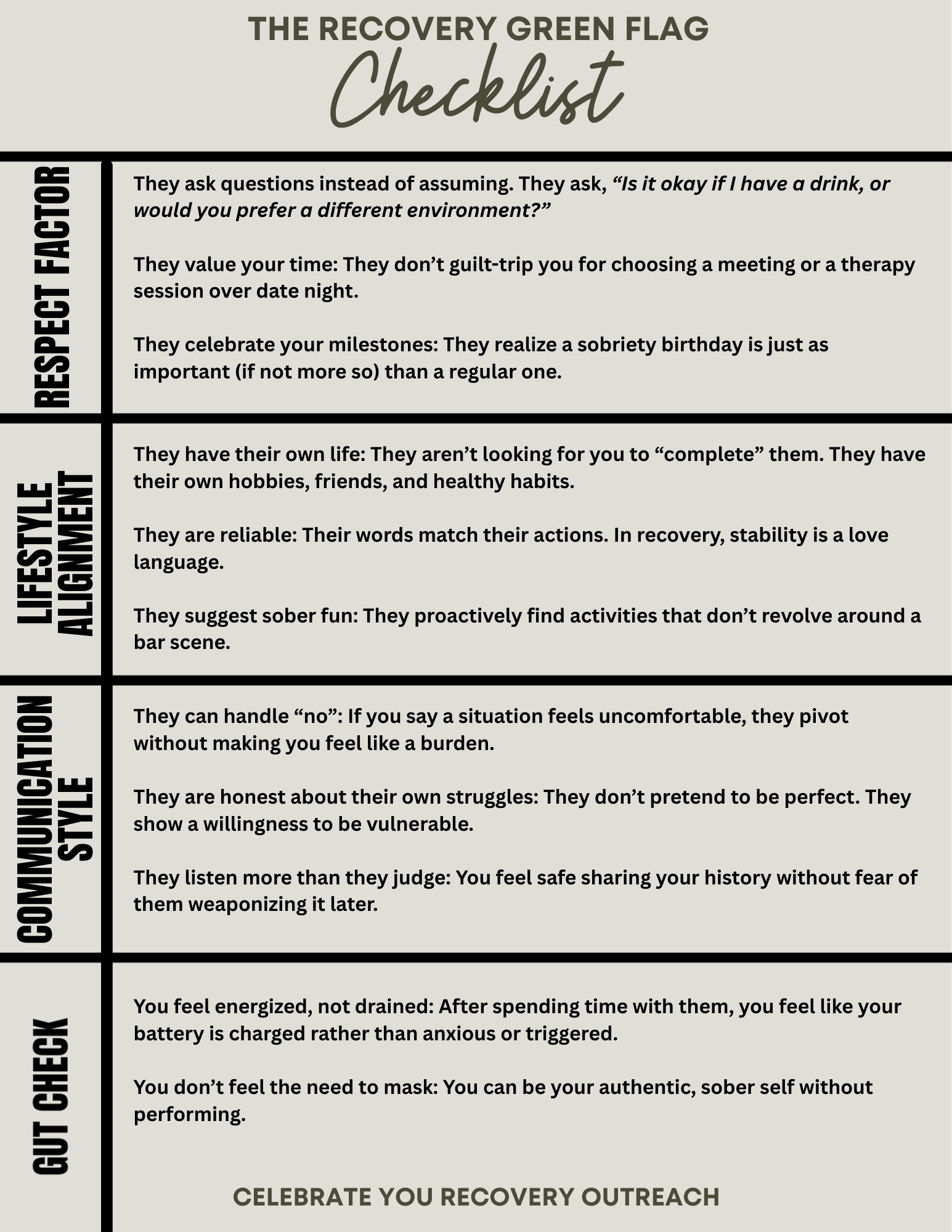
If your date wants to go to a bar or a party where the vibe is centered on drinking, it’s okay, and necessary,to say no. A partner who respects your journey will have no problem pivoting to a different plan.
You don’t have to lead with your entire life story in the first five minutes over coffee, but don’t hide it either. If they can’t handle your past, they don’t deserve your future.
Boundaries are what keep you from nose diving off the cliff. In the early stages of dating, it’s easy to let them slide because you want to be liked and you crave connection — but that’s where the danger lies.
Lessons from the Trenches
My standards are high because my lessons were heavy.
I’ll be the first to admit I messed shit up. I once fell for someone and convinced myself that love was enough. I stopped going to meetings because I wanted to spend every second with them. I lowered my standards and started hanging out in places I knew I didn’t belong. I let shit slide hoping for change.
The result? Not only did the relationship completely burn to the ground — so did I.
I neglected my needs and didn’t hold my boundaries, all because I didn’t want to live a life without him in it. The emotional, physical, and mental toll that resulted is something I’m still recovering from.
The longer you wait to get off the wrong train, the farther and harder it is to get back. That relationship led me back to drinking and required me to completely rebuild my life.
When you stop holding your standards, you start losing bits of your identity. I learned the hard way that if a relationship requires you to compromise your recovery, it isn’t a relationship — it’s a distraction.
Respect isn’t just about how they treat you, it’s also about how they respect the work you’ve put into yourself.
The goal is to build a life that doesn’t crumble when someone exits.
Unfixable
One thing I majorly struggled with was my desire to save everybody.
When I found myself in a relationship with a partner who was drinking or using, instead of highlighting the dangers and the potential it had to destroy me, I approached them with empathy and compassion — because who was I to judge their struggle when in the past I shared similar demons? I felt it was unfair. I felt that I could love them through it.
I thought my temporary suffering would suffice for long-term happiness if I stuck by them and showed them I’d stay for their darkest moments.
Until their darkest moments also became mine.
Their problems overtook me. Their behaviors influenced my decisions. And I ended up in a worse spot than them.
This is not me telling you to abandon the one you love and watch them fall on their face. This is me telling you that no amount of love can save someone else who doesn’t want to be saved.
This is me telling you to be firm in your boundaries. They’ll be fine. Don’t become someone else’s collateral damage.
It’s not your job to change someone else or put in the work for something they may or may not want to be better off without. You find someone who already aligns with your values and future goals.
Non-Negotiable’s (Not Preferences) 100% Dealbreakers
That’s why non-negotiable’s are a must.
Not preferences. Not “nice to haves.”
Non-negotiable’s.
What this looks like:
Respect for my sobriety — no jokes about it, no pressure, no “just one won’t hurt.” Emotional availability. Consistency. Accountability. Someone who can communicate without manipulation or games. And most importantly, someone whose lifestyle doesn’t threaten the stability I worked so hard to build.
Sobriety taught me that peace is more valuable than passion and that butterflies can sometimes be warning signs.
Dating sober means choosing alignment over chemistry, clarity over chaos, and long-term peace over short-term validation. It means being willing to walk away — even when you really, really don’t want to.
Building a Life Together
The best part about dating in recovery is discovering that “fun” doesn’t have to be blurry. Finding mutual interests that support your lifestyle is key to a lasting bond.
A healthy partner won’t just tolerate your recovery — they’ll celebrate it. They will understand that your Tuesday night meeting is non-negotiable and that your sobriety is what makes you the person they love in the first place.
When the connection is real you won’t find the need or desire to partake in activities that bring arguments, tension, and conflict. You won’t be willing to put one another in triggersome environments. Someone that wants a life or a future with you is going to support you being the best version of yourself on the way there.
Someone who knows your tiggers, and triggers you anyways, does not love you.
The Bottom Line
Keep your standards high, your boundaries firm, and walk confidently with an honest heart.
You’ve worked too hard for this version of yourself to give it away to someone who doesn’t see its value.
Getting sober was the first act of self-love. Dating sober is a test.
Choose the kind of love that nurtures the man/woman you are becoming. The love that protects your peace — not the kind that makes you have to recover all over again.